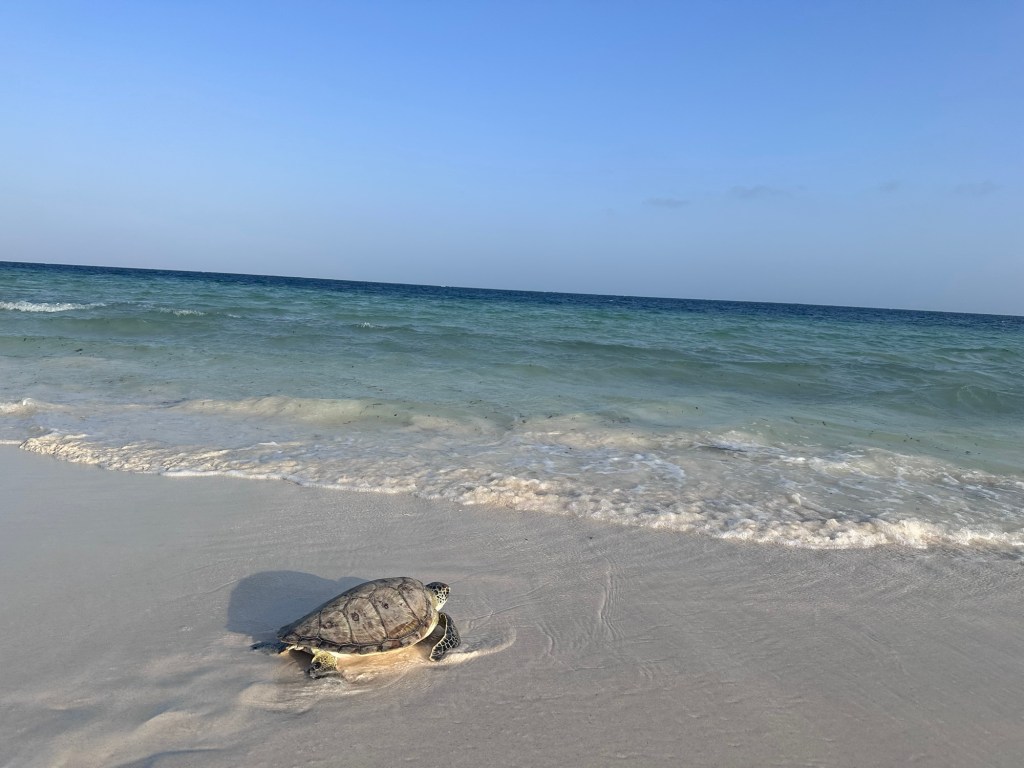
In case you didn’t get it from the title, my time in Kenya was magical. I was volunteering with Local Ocean Conservation (LOC), an incredible organisation who have been protecting sea turtles, mangroves and the ocean for 27 years, rescuing over 23,800 turtles so far. I learnt so much and it was one of the best and most fulfilling experiences of my life to date.
Watamu is a beautiful coastal town north of Mombasa with white sandy beaches, up-market hotels and kite surfers galore. For some reason it’s full of Italians so all the kids shout “ciaoooo!” at any tourist they see assuming you must be Italian too. The Italian influence has unsurprisingly made its way into the cuisine, with pizza and pasta on every menu. It’s also a fun place, culminating in a Saturday beach party which seemed to have attendance from everyone in town.
The LOC team were incredibly welcoming and friendly, and within the first few daily tea breaks it felt like we’d been part of the same team for much longer than we had. I’ll try to share what I learnt without this sounding like a mediocre science(ish) textbook by only sharing the most interesting facts, which I hope you find as fascinating as I do.
There are 7 types of sea turtle which can be identified by the characteristics and number of scutes on their carapace (shell) and head. 5 of them are found in Kenya, which in order of prevalence are green turtles (green skin not shells), Hawksbill (overlapping scutes), Olive Ridley (small and olive-coloured), Loggerhead (muscly head…) and Leatherback (thick leathery back rather than the traditional scutes). (I did say science-ish).
The first thing I learnt during rescue 1 on day 1 is that sea turtles can be huge, powerful and a bit scary. After a long overnight flight and some orientation sessions I was ready to call it a day, but at around 7pm we were told about a turtle rescue and turtles come first here. She had been found on a busy beach, confused by tourists while trying to nest. She weighed a staggering 122kg, requiring at least 5 people to carry her, partially due to her powerful flapping flippers. She was assessed as healthy but pregnant so we released her back into the sea, hoping she would soon return to a quieter part of the beach to lay her eggs safely. Many more rescues followed, most of which were thankfully smaller green turtles.
Cue some fun (and not so fun) facts. First, turtles are solitary animals meaning they spend their life entirely alone, except when born and when mating. Most of us appreciate our alone time, but turtles take this to the extreme. Straight after laying up to a hundred eggs on the beach, female turtles go back into the sea and never return to check on their offspring, and never see them again. When the eggs hatch, the hatchlings make their way to the sea to start their own solitary lives. Imagine the chaos if all human mums gave birth in hospital and then went home never to set eyes on their babies again!
One of the most perplexing facts I learnt is that every female sea turtle returns to the exact beach they were born on to lay up to 100 eggs at a time, up to 900 per year. No matter how far these migratory creatures travel, they always find their way back by using the earth’s magnetic field as a compass to find the unique magnetic signature of their birthplace. As someone who can barely navigate around the town I grew up in without the help of Google Maps I find this highly impressive.
Third and final fun fact: the gender of sea turtles is determined by the temperature at which they hatch – the higher the temperate the more females, the lower the temperature the more males (“hot girls, cool guys” is apparently a good way to remember it…). But you can’t tell the gender of a juvenile turtle until they are adults, which in a life span of up to 100 years is tens of years down the line, and even then you can only tell by the size of their tail.
Time for the not-so-fun facts. 6 out of 7 types of sea turtle are endangered, and all of the causes are human-made. First, plastic pollution – more and more turtles are accidentally consuming plastic, and when they do the gases make the turtle float to the top of the sea, which means they can’t get down to eat and they are also at risk of being hit by boats. Pollution and plastic are also believed to be the cause of a contagious turtle disease called fibropapillomatosis which causes tumours that are killing turtles worldwide. The LOC team do a weekly beach clean up with volunteers and local communities which helps locally, but we all need to play our part by recycling plastic and keeping beaches and the ocean clean worldwide.
As you now know, turtle genders are affected by temperature, so as climate change increases the temperature of the earth and seas it is creating a gender imbalance, reducing the amount of nesting turtles due to lack of males. As you also now know, turtles live for up to 100 years and always return to their birth beach to lay their eggs. Often these beaches have now been built on, with hotels, sun beds and bright lights disorientating turtles like rescue #1, putting them in danger and deterring them from laying their eggs.
Fishing net entanglement is also a major cause of harm and is the most common reason for LOC’s rescues. The team in Kenya have built an impressive rapport with local fisherman, who call their hotline if they accidentally catch a turtle (“bycatch”) so they can be assessed and released safely if healthy, or treated if not. But this doesn’t happen everywhere or at all times, and old abandoned nets are also a problem.
Sadly poaching is also an issue, either for their meat or oil which some believe to be medicinal. The authorities in Kenya appear to be taking it seriously with fines of up to 20 million Kenyan shillings or life in prison but we did some anti-poaching surveys while we were there and it is definitely still happening – we found an entire fresh turtle carcass washed up, as well as several turtle scutes and ribs.
LOC are doing everything they can to help protect sea turtles from these dangers with programmes they have fine-tuned over the last 27 years, all of which I had the chance to take part in. From a preventative standpoint they provide education to schools, tourists and local communities to explain why the ocean needs protecting and how they can play their part. The bycatch and release programme which relies on building and fostering good relationships with local fishermen has rescued over 23,800 turtles so far. If the turtle is injured or unwell, they have built an impressive Turtle Rehabilitation Centre to efficiently get that turtle healthy enough to be released back into the sea with minimal distress or human interaction.
After these mostly daytime activities, LOC carries out a night patrol where they walk up and down the beach from 2-3 hours before high tide, to 2-3 hours after, to protect nesting turtles as they come ashore to lay their eggs. The night I took part this meant walking from 7pm to 1am on sand with only a few short breaks. It was a fascinating experience under a magical starry sky, but after nearly 39,000 steps that day, I was mostly just impressed by and in awe of the dedication of the night patrol team who do this every single day.
Beyond turtles I also learnt a lot about mangrove trees, their importance to turtles and other species, that they protect infrastructure from storms and surges, and that they can also be poached. We helped with seed collection, potting, planting and surveys and every one of these activities was really hard work in 30 degree heat. There are also different kinds of mangrove trees which can be identified by their leaves, but I won’t spell them out (partially because I wouldn’t know how to).
I feel inspired by both the turtles themselves and the team at LOC, who I can’t thank enough for their hospitality, and we should all thank for the amazing work they are doing to support sea turtles and mangrove populations in Kenya and beyond. Every member of their small team is so knowledgeable and dedicated to their piece of the LOC puzzle that when put together protects sea turtles and the ocean from harm.
I am now in Tanzania, having just spent a few days in Zanzibar before a safari. With my newfound knowledge of and love for turtles it was sad to see multiple “natural” sea turtle aquariums as a main tourist attraction, where fishermen bring the turtles they catch to a tiny pool so tourists can touch and swim with them, rather than make sure they get safely back into the sea (for the record I refused to go to avoid contributing anything towards this activity.) It made me even more appreciative of and impressed by the work the LOC team are doing in Kenya, and how much it’s needed elsewhere. Other than that, Tanzania is beautiful, from picturesque beaches to amazing wild animals, which I’ll be writing about next!

 aroundtheworldinkatydays.blog
Leave a comment